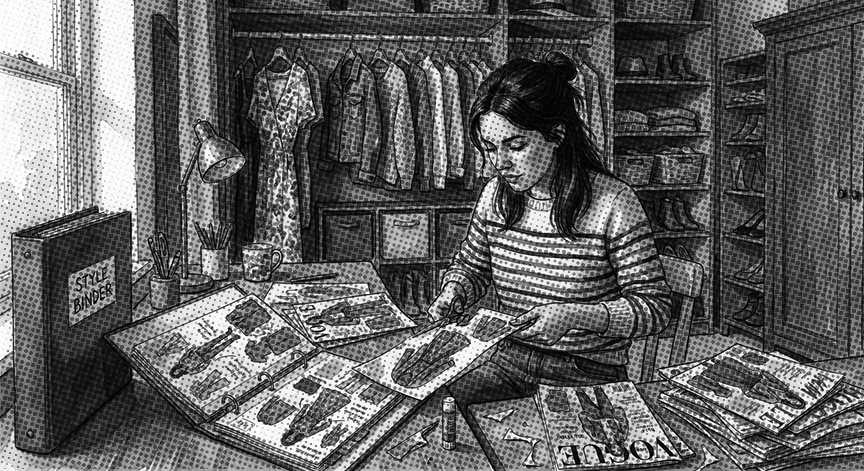
I keep a three-ring binder stuffed with page protectors. Inside are cutouts from apparel catalogs: sweaters that look nearly exactly like the ones I already own, outfits that still look like me. When I want something new, I flip through that book first. Half the time I realize I already have the look. The other half, I wait. That pause has done more to curb my shopping than any “no-buy” pledge.
This is not a capsule-wardrobe lecture. It is a cheap, analog system for shopping your own closet before you shop anyone else’s.
Why catalogs still work
Catalogs force a different kind of looking than a phone. You see the whole outfit on a page: fabric drape, color next to skin, how a jacket sits over trousers. When I cut those pages out and slide them into protectors, they become a visual inventory and a mood board at once.
Two kinds of pages go in:
- What I already own. If a catalog model is wearing something close to a piece in my closet, I save it. Later I can “shop” that page instead of adding another black turtleneck.
- What I decided to buy. If I order something after seeing it styled, I keep the page. It reminds me why I chose it and how I planned to wear it. That memory is useful six months later when the same silhouette shows up again in a new catalog.
The binder sits where I actually get dressed and where I used to browse sales. Physical pages slow the click. They also survive app updates and forgotten logins.
How to start one
You need a binder, a stack of page protectors, scissors, and the catalogs you already receive (or a few you request once). That’s it.
- Pull catalogs you actually like. Skip the ones that never match your life.
- Cut full outfits or single pieces that either resemble what you own or represent a purchase you already made.
- Slip each page into a protector. Group loosely: knits, work, weekend, coats. Perfection is not the point.
- Add a few notes on a sticky if you want: “navy merino, 2024,” “too similar to the gray cardigan.”
- Flip through it before I get dressed or open a shopping tab or walk into a store.
When a new catalog arrives, you already have a filter: Does this add something the binder does not already show me?
Fast fashion runs on forgetting what you own
The industry produces well over 100 billion garments a year. Textile waste is measured in tens of millions of tonnes. Fashion’s climate emissions have been rising again, driven in part by more fiber production—especially polyester.
Impulse buying thrives on a simple gap: you cannot see your whole closet while a new photo is in front of you. A binder closes that gap without requiring a photo of every hanger.
Shopping your closet is not new advice. What changes the outcome is having a portable, visual record of what already works. Digital closet apps help some people. Paper helps others because it is slower and harder to ignore.
Why I stick to cotton, wool, and other natural blends
I buy cotton, wool, linen, and blends of those fibers. Not because they are morally perfect—cotton uses a lot of water; wool has land-use costs—but because the clothes last in a way that matches how I actually live.
Quality natural pieces tend to soften, hold shape when constructed well, and feel better against skin. Wool resists odor, so it needs fewer washes. Cotton and linen breathe.
Synthetics can be tough on paper, but they pill, trap smell, and shed microfibers when washed. Longevity is the sustainability that actually shows up in a closet: fewer replacements, lower cost per wear, less “I have nothing to wear” while the rail is full.
Natural fibers also biodegrade more readily when they are not heavily blended with plastic. That matters at the end of a garment’s life, which should be years away if you bought it on purpose.
What this is not
It is not a ban on new clothes. It is a filter. Buy the wool trousers if they fill a real gap the binder keeps showing you. Skip the third almost-identical tee.
It is not minimalism as aesthetic. It is fewer mistakes. The goal is a closet you can actually use, not a smaller number for its own sake.
Try it for one catalog season
Request or keep two catalogs you already trust. Cut ten pages. Put them in protectors. Leave the binder where you get dressed. Before the next order, flip it.
You may find you already own the outfit. You may find the thing you wanted last month still looks right—and that is a good reason to buy it in a fabric that will last. Either way, you have interrupted the fastest part of fast fashion: the moment between desire and checkout.
##