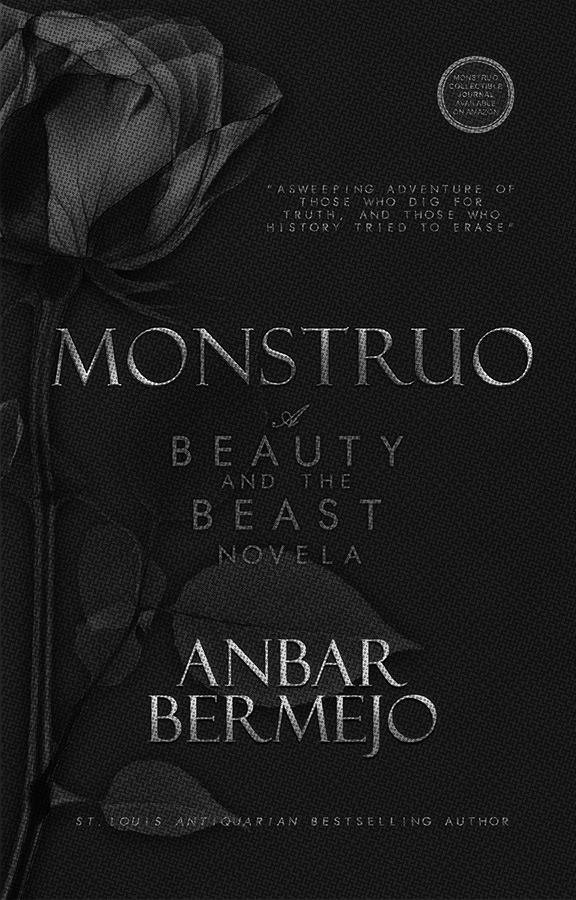
In “Monstruo,” Anbar Bermejo reimagines Beauty and the Beast against the haunting backdrop of a forgotten Spanish mission, where the greatest mysteries are not always buried beneath the earth.
There is something unsettling about abandoned places of worship. Their crumbling walls preserve more than the memory of prayer; they hold the echoes of generations, the weight of forgotten promises, and sometimes, the suggestion that certain secrets were never meant to be uncovered.
It is within this atmosphere of sacred decay that Anbar Bermejo sets Monstruo: A Beauty and the Beast Novela, a Gothic romance that draws upon the enduring fascination with forbidden love, supernatural mysteries, and the fragile boundaries between faith and superstition.
At the center of the story is Isabela de la Cruz, an archaeologist whose search for a mysterious silver bowl leads her to the deteriorating Mission San Cristóbal Canis. What begins as an investigation into an obscure relic soon becomes something far more disturbing.
There she encounters Bastián Tenorio, an elegant and enigmatic stranger whose intimate knowledge of the mission raises troubling questions. His presence is both alluring and unsettling, particularly when even his shadow appears unwilling to obey the ordinary laws of nature.
The familiar architecture of Beauty and the Beast is unmistakable: a curious young woman, a mysterious man, and an attraction complicated by the possibility of something monstrous. Yet Bermejo relocates these elements from the enchanted castles of European folklore to a world shaped by Spanish colonial history, religious traditions, and supernatural uncertainty.
This change of setting offers an intriguing literary possibility. The mission is not merely a backdrop for romance but a place where competing interpretations of the world converge. Archaeology seeks evidence; religion seeks meaning; folklore preserves what official histories sometimes overlook.
For Isabela, whose profession depends upon the careful examination of the past, the encounter with Bastián presents a particular contradiction. How does one investigate a mystery when the evidence itself appears to resist rational explanation?
The novel’s central romance emerges from this uncertainty. Attraction and suspicion become inseparable, and the question of Bastián’s true nature introduces a tension that reaches beyond physical appearances.
What, after all, makes someone a monster? Is monstrosity something visible, something inherited, or something revealed through the choices we make?
These questions have sustained the Beauty and the Beast tradition for centuries, but the Gothic setting of Monstruo gives them a distinctly spiritual dimension. Here, the supernatural is intertwined with the sacred, suggesting a world in which love, fear, and belief cannot easily be separated.
The book belongs to a literary tradition in which old buildings conceal moral histories, beautiful strangers harbor dangerous secrets, and the past refuses to remain silent. Its premise invites comparisons with Gothic romance while preserving the emotional framework of a classic fairy tale.
For readers drawn to atmospheric mysteries, slow-burning romance, and stories where historical settings meet the inexplicable, Monstruo offers an invitation into a world where every discovery threatens to uncover another secret.
And perhaps that is the enduring attraction of stories about monsters: beneath their supernatural disguises, they return us to an uncomfortable human question.
When confronted with something we do not understand, are we more afraid of the monster before us—or of what it might reveal about ourselves?
Discover the book: https://www.goodreads.com/book/show/259920200-monstruo
Anbar Bermejo | Gothic Romance, Historical Mystery & Literary Fantasy